Shiv Patel · Chartered Accountant (ICAS)
Tax year 2026/27Published Last reviewed Checked for 2026/27 rates
How much should I save each month? Four steps (UK)
There is no single right amount to save each month. A figure often quoted is 20%. It comes from the 50/30/20 rule, which puts 20% towards savings and debt repayments together[1], so it is a starting point to test rather than the answer. The figure doesn’t have to be large either. MoneyHelper says saving smaller, regular amounts is often more effective than saving larger amounts now and again, because it builds the habit without overcommitting[2].
The actual figure you can achieve comes from four steps, in order: what is left after essentials, any costly debt, whether an emergency fund is in place and what a named goal needs by its date. When any of those changes, so does the amount.
How do I work out how much I can save each month?
Four steps, on a normal month:
- Work out what’s left. Take-home pay minus essential bills (rent or mortgage, Council Tax, energy, food, travel and minimum debt payments) and your usual spending. That’s the most you can save without cutting back. Spread yearly bills monthly too, in a sinking fund.
- Costly debt first. MoneyHelper says paying off credit cards, unauthorised overdrafts and payday loans before building the emergency fund is cheaper in the long run[2].
- Top up your emergency fund. If it isn’t full, put part of what’s left towards the gap. The next section covers how big it needs to be.
- Save for your goal. Divide what’s still needed by the months until you need it. If steps 2 to 4 come to more than step 1 leaves, push the date back or lower the target. Set the saving to go out on payday, as a 2017 review for HM Treasury and the FCA recommends[1].
A worked example: emergency fund and holiday
The figures are illustrative, for one fictional person, not typical or average amounts.
Alex takes home £2,300 a month. Essential outgoings come to £1,350 and the rest of Alex’s usual spending to £500. Alex has £1,650 saved and clears a credit card in full each month. The goal is a £1,800 holiday in 12 months.
- What is left: £2,300 less £1,350 and £500 leaves £450 a month.
- Debt: nothing to add, as the card is cleared each month.
- Emergency fund: Alex picks three months of essentials, which is £4,050. With £1,650 saved, the gap is £2,400: £300 a month over 8 months.
- Goal: £1,800 over 12 months is £150 a month. With the emergency fund’s £300 that makes £450, which fits.
| Months | Emergency fund | Holiday |
|---|---|---|
| 1 to 8 | £300 | £150 |
| 9 to 12 | £0 | £150 |
From month 9 the emergency fund is full, so its £300 a month is free. It can bring the holiday forward, start a new goal or go on spending.
How much emergency fund should I have?
MoneyHelper’s rule of thumb is three to six months’ essential outgoings in an instant access savings account[2]. Essential outgoings are the costs that can’t stop: rent or mortgage, food, heating and the other bills. MoneyHelper’s example is someone spending £1,000 a month on those, who might aim for £3,000 to £6,000[2].
Where in that range is a judgement about how much there is to fall back on. One income, or pay that changes month to month, leaves less than two steady incomes. Instant access means the money can be reached quickly, without a notice period.
Only the gap needs a monthly amount. In the worked example, three months of Alex’s £1,350 essentials is £4,050. With £1,650 already saved, the gap is £2,400, which at £300 a month takes 8 months.
MoneyHelper puts costly debt first. It lists credit card debt, an unauthorised overdraft, payday loans, home credit and mortgage arrears as debts that would be cheaper in the long run to pay off first[2]. If other credit is low cost or under control, it says adding to the emergency fund makes sense[2]. For free, impartial help with debt, contact MoneyHelper (moneyhelper.org.uk).
How much of my salary should I save?
A percentage of salary is a starting point to test rather than an answer. The 50/30/20 rule puts 20% towards savings and debt repayments[1], so its 20% has to cover both. Running that share through the four steps shows whether it covers the emergency fund, the debt and the goal by their dates.
A workplace pension is saving taken before pay lands. Under automatic enrolment the minimum is 5% from the employee and 3% from the employer, 8% in all[3], in most schemes worked out on earnings between £6,240 and £50,270 a year before tax[3]. A monthly figure from the four steps comes on top of that.
Help to Save, open to certain people receiving Universal Credit, takes payments of between £1 and £50 each calendar month[4] and adds a bonus of 50p for every £1 saved over 4 years[4].
Is saving £200, £500 or £1,000 a month good?
It is good if it fits the four steps: the emergency fund, any costly debt and the goal’s date. The same amount is a very different share of different take-home pay:
| Monthly take-home (salary) | £200 a month | £500 a month | £1,000 a month |
|---|---|---|---|
| £2,093.30 (£30,000) | 9.6% | 23.9% | 47.8% |
| £2,693.30 (£40,000) | 7.4% | 18.6% | 37.1% |
| £3,293.30 (£50,000) | 6.1% | 15.2% | 30.4% |
Take-home is pay after Income Tax and National Insurance in 2026/27, outside Scotland, with no pension or student loan. It uses the £12,570 Personal Allowance[5], the 20% basic rate on £12,571 to £50,270[5] and employee National Insurance of 8%[6]. Is £40k a good salary in the UK? works it through step by step and has a calculator for what is left after rent and bills.
For comparison, UK households saved 8.8% of their disposable income in April to June 2026[7]. That’s a household average that includes pension saving, so treat it as a rough guide, not a target for one person. On these figures £200 a month on a £30,000 salary is close to that rate. £500 a month on £40,000 is about twice it.
A higher share is not better if it leaves essentials short or a costly debt growing. The four steps decide that, not the percentage.
When should I change how much I save?
Whenever one of the four steps would give a different answer. A full emergency fund, as in month 9, is one case. The others:
- Essential outgoings change. The emergency fund target moves with them. In the example, a £100 rise in rent adds £300 to three months of essentials, so the fund needs a £300 top-up while £100 less is left each month.
- A debt ends or starts. A finished repayment frees its monthly amount. A new one comes out of what is left.
- A goal is reached or its target or date moves. A reached goal frees its monthly amount. Otherwise the sum is redone: what is still needed, divided by the months left.
- Pay changes. A rise or a cut changes step 1 and every figure after it.
How do people normally work this out?
The usual starting points are a rule or a round number: a percentage of pay, whatever is left at the end of the month, the amount a friend saves. Savings calculators are the other common route.
Each gives a number quickly, but each misses something. A percentage doesn’t know how much of the emergency fund is still to build or when a goal is due. Whatever is left at the end of the month can be nothing, because spending fills the gap first. A savings calculator turns a target and a date into a monthly amount, but doesn’t check whether that amount fits what is left after essentials. And a figure that worked last year can stop working when rent, pay or a debt changes.
How you’d do this in Surplus
Surplus connects to UK current accounts and credit cards through read-only Open Banking from Yapily, an FCA-authorised payment institution, so the monthly surplus is worked out from real income, bills and spending. Surplus can’t move your money.
Surplus shows what is safe to spend this month, how Lifestyle spending, bills, essentials and income affect that figure and what you are forecast to have left at month-end. The month-end forecast is step 1, worked out from your own accounts and plan. Open the Safe to spend card on Home, or Breakdown in Growth. Setting up the plan behind Safe to Spend is part of Surplus Pro.
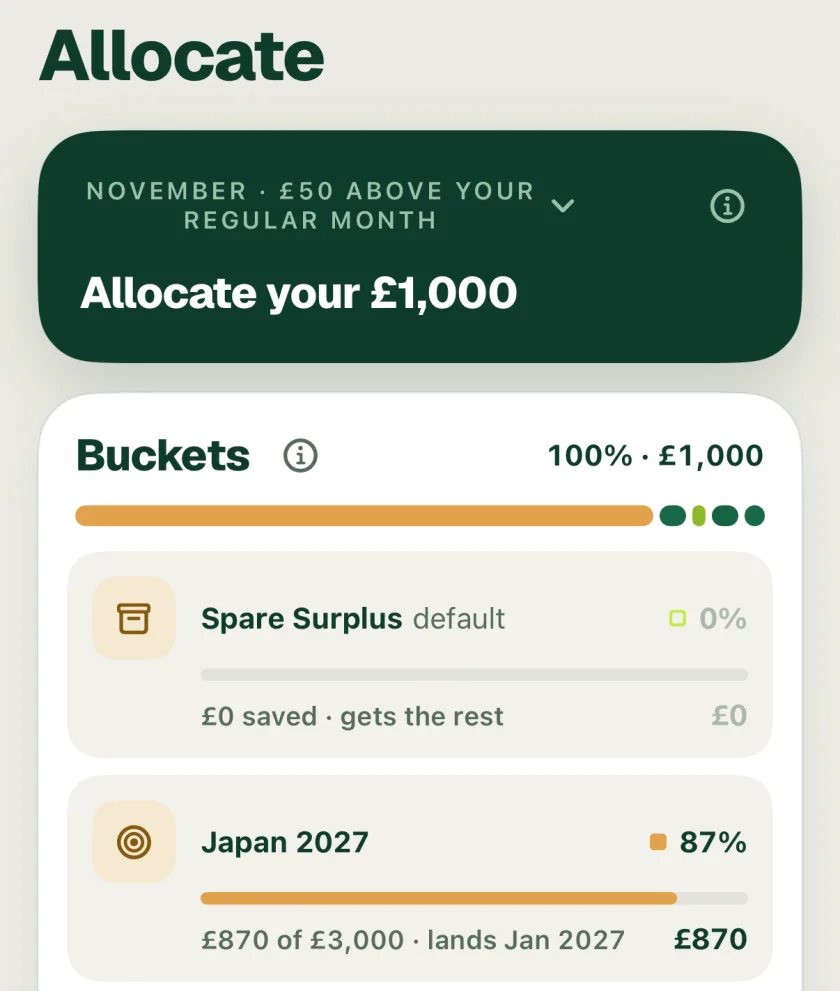
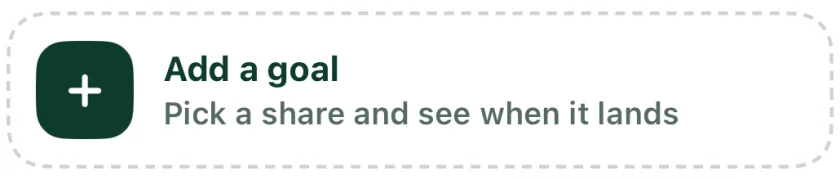
In Allocate, part of Surplus Pro, choose Add a goal in the Buckets card. Name your goal, enter its target amount and choose a share of your monthly surplus. Surplus shows this month’s planned contribution and projects when you’ll reach the target. The pound amount varies with each month’s surplus. In an illustrative example, an 11% Holiday share is £393 on a £3,578 surplus and £89 on an £814 one. There’s no date to pick, because the share sets the projected month. Allocate plans where the money goes; the transfers are yours to make.
Safe to spendReview
Safe to spend
£564 left
£28 a day for the 20 days left. Spend up to £564 more on lifestyle spend and you still hit your target.
How it adds up
Lifestyle planFor the whole month£425
Lifestyle spentNot bills or essentials−£8
Fixed Costs£962 paid of £966 expected by today+£4
Essentials£90 spent of £233 expected by today+£143
Income£0 landed of £0 expected by today£0
Safe to spend£564
Safe to spendToday, from above£564
20 more days expected spendLifestyle, 11 to 30 November−£283
Under plan by month-end+£281
Your target£1,000
Month-end forecast£1,281
Ask aboutsafe to spend
Ask Surplus AI · Surplus Pro
- How does my safe to spend add up?
- How do you forecast my month-end surplus?
- What could change the forecast?
AI can make mistakes. For education only, not financial advice.
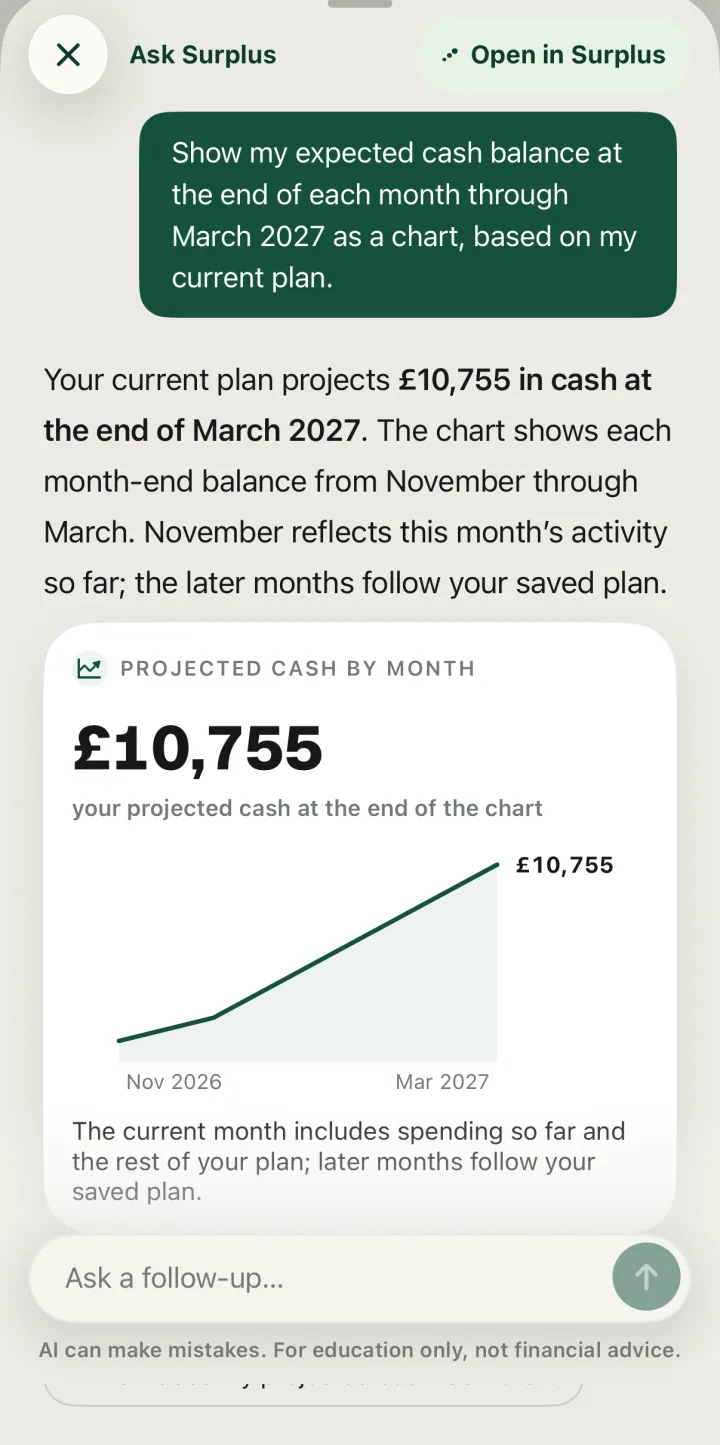
Ask Surplus, part of Surplus Pro, to show your projected cash balance over the coming months, based on your current plan. You can also ask how a planned expense would change it. AI can make mistakes. For education only, not financial advice.
In Surplus Free, Add a virtual bucket in Net Worth records savings held in accounts Surplus can’t see. The Your Complete Picture feature page shows net worth in the app.
Sources
Every figure above is checked against these primary sources - and re-checked whenever the rates move.
| Source | Accessed |
|---|---|
| Emergency savings: how much is enough? - MoneyHelper www.moneyhelper.org.uk/en/savings/types-of-savings/emergency-savings-how-much-is-enough | |
| Rules of Thumb and Nudges: Improving the financial well-being of UK consumers - Financial Advice Working Group report for HM Treasury and the FCA www.fca.org.uk/publication/research/fawg-rules-of-thumb-nudges.pdf | |
| Workplace pensions: what you, your employer and the government pay - GOV.UK www.gov.uk/workplace-pensions/what-you-your-employer-and-the-government-pay | |
| Get help with savings if you're on a low income (Help to Save) - GOV.UK www.gov.uk/get-help-savings-low-income | |
| Income Tax rates and Personal Allowances - GOV.UK www.gov.uk/income-tax-rates | |
| Rates and thresholds for employers 2026 to 2027 - GOV.UK www.gov.uk/guidance/rates-and-thresholds-for-employers-2026-to-2027 | |
| GDP quarterly national accounts, UK: April to June 2026 - ONS www.ons.gov.uk/economy/grossdomesticproductgdp/bulletins/quarterlynationalaccounts/apriltojune2026 |
Common questions
Is 10k a good amount of savings? +
It depends on what it is for. As an emergency fund, measure it in months of essential outgoings: £10,000 is six months at about £1,670 a month of essentials, or three months at about £3,330. Beyond the emergency fund, it depends on the goals being saved for and their dates.
Is 30k a good emergency fund? +
Measure it in months, not pounds. Divide it by monthly essential outgoings: at £2,000 a month, £30,000 is 15 months, well above MoneyHelper's rule of thumb of three to six. Money beyond the emergency fund's target is then free for goals with a date.
How much savings should I have? +
For emergencies, MoneyHelper's rule of thumb is three to six months' essential outgoings. Beyond that there is no single figure. It depends on the goals being saved for and when each is needed, which is what the four steps in this guide work out.
What if nothing is left to save at the end of the month? +
Then the steps give a monthly figure of £0 for now and the work moves back to step 1: the essentials, the usual spending and the income behind them. Whatever a change there frees up becomes the first monthly figure, taken in the same order, so the emergency fund comes before a goal.
Is it better to save a fixed amount or a percentage? +
Each has a trade-off. A fixed amount is predictable and keeps a goal on its date, but it can be too much in a month with a large bill. A percentage of what is left moves with the month, rising when more is left and shrinking when less is. The goal's date then moves instead of the month's budget.
Researched and written by Shiv Patel, chartered accountant (ICAS), with AI drafting assistance. Every figure is checked against the cited source. Guidance, not personal advice.