Shiv Patel · Chartered Accountant (ICAS)
Tax year 2026/27Published Last reviewed Checked for 2026/27 rates
Average cost of a wedding UK: budget by guest count
The average UK wedding cost £24,069 in a Bridebook survey of 4,000 newlyweds that MoneyHelper quotes, in an article last updated in February 2024[1]. That figure includes the rings and a honeymoon, so the day itself costs less. Your own total moves with the guest count: catering averages around £70 a head[1].
Averages differ from survey to survey, partly because of what each one counts. This guide breaks a wedding down cost by cost, prices a registry office ceremony, works a budget for 35 and 100 guests and turns it into a monthly amount.
What goes into a wedding cost breakdown?
Every wedding cost sits in one of two groups:
- Per-guest costs rise with every name on the list: food, drink, invitations, favours, table flowers and chair hire.
- Fixed costs stay the same for 30 guests or 130: the ceremony, outfits, rings, photography, music and transport.
The venue sits between the two. Its hire fee stays put until the list outgrows the room and then jumps to the price of a bigger one.
MoneyHelper’s top five wedding costs are the venue, the honeymoon, food, the engagement ring and drinks, in that order[1]. Its averages for the main lines:
| Cost | MoneyHelper average | Per guest or fixed |
|---|---|---|
| Venue | £8,400 | Fixed, until the list outgrows the room |
| Catering | around £70 a head | Per guest |
| Wedding dress, with shoes | £1,400 | Fixed |
| Wedding suit | £300 to buy, from £50 to rent | Fixed |
| Photographer | £1,300 to £1,700 | Fixed |
| Four-piece band | £1,200 to £1,600+ | Fixed |
| DJ | £200 to £800 | Fixed |
| Wedding cake | £300 to £400 | Fixed |
| Flowers, without table pieces | from £350 | Fixed; table pieces add to it |
| Wedding car | £300 to £600 | Fixed |
Source: MoneyHelper, How much does an average wedding cost?[1]. Last updated in February 2024, so prices may have moved since.
A national average can’t see the guest list. It averages lists of every length, while a budget follows the length of one.
How much does a registry office wedding cost?
In England and Wales the legal part of a wedding has a published price. A registrar costs £62 at a register office[2] and £114.50 at a registered religious building[2]. At other approved venues, such as a hotel or a stately home, costs may be different[2]. A religious ceremony needs an authorised person, such as a minister. If the venue doesn’t have one, a registrar is booked at the £114.50.
A civil ceremony needs at least 2 witnesses[2]. So the smallest legal wedding is the couple, 2 witnesses and a registrar. At a register office the registrar’s part is £62. Ask the register office what else it charges for, such as giving notice and certificates.
Giving notice sets the timeline. It must be done at least 29 days before the ceremony[3] and the ceremony must then take place within 12 months[3]. Scotland and Northern Ireland have their own rules and fees.
Every guest beyond the witnesses is a choice that brings the per-guest costs with it.
How do I set a wedding budget?
Start from the guest list rather than the venue, in five steps:
- Settle the guest count. Every per-guest line depends on it. So can the venue.
- Price one guest. Add up what a single guest costs across food, drink and the other per-guest lines, then multiply by the guest count.
- Add the fixed costs. One line each for the ceremony, venue hire, outfits, rings, photography, music and transport, from quotes where there are any. Add a line for the extras that turn up late.
- Mark each line essential or optional. Beyond the ceremony, which lines are essential is the couple’s call. The optional ones are where the total can give later.
- Add up every line. That is the target.
MoneyHelper puts the average guest list at between 80 and 100 people[4] and says cutting it from 100 to 80 could save as much as £1,400 on catering alone[4].
Worked example: a wedding budget for 35 and 100 guests
The figures are illustrative, for one fictional couple, not typical or average amounts. The exception is catering, which uses MoneyHelper’s figure of around £70 a head. The other per-guest costs come to £30 a head and the fixed costs to £6,000.
| Illustrative budget | 35 guests | 100 guests |
|---|---|---|
| Catering at £70 a head | £2,450 | £7,000 |
| Other per-guest at £30 | £1,050 | £3,000 |
| Fixed costs | £6,000 | £6,000 |
| Target | £9,500 | £16,000 |
The formula is: guests × cost per guest + fixed costs = target. Each guest costs £100 in this example, so the 65 extra guests add £6,500 and the target rises by more than two-thirds. If 100 guests need a bigger venue, the fixed line rises as well.
For a real list, the number to find is that cost of one more guest. With it, each name on the maybe list has a price.
The date moves the price too. MoneyHelper puts the peak season at April to September[4] and says a summer wedding could cost up to 4 times as much as a winter one[4].
How much do I need to save each month for a wedding?
Four more steps turn the target into a monthly amount:
- Start from the target.
- Take off what is already set aside and any money family has promised.
- Count the months until the money is due. Deposits are paid at booking and balances on the dates in each supplier’s contract, which can be weeks before the day. The deadline is the last balance date, not the wedding.
- Divide what is left to find by those months. That is the monthly amount.
In the 35-guest example the couple have £2,300 set aside and the last balance falls due in 18 months. That leaves £7,200 to find, or £400 a month. With 100 guests the same steps leave £13,700 to find, or £761.11 a month: each extra guest adds about £5.56 a month for 18 months.
The timeline moves the answer too. With 12 months to go instead of 18, the same £7,200 is £600 a month.
Money from family comes off in step 2. For Inheritance Tax, a wedding gift is tax-free up to £5,000 from a parent[5], £2,500 from a grandparent or great-grandparent[5] and £1,000 from anyone else[5]. A giver can combine that with the £3,000 of gifts anyone can make each tax year without adding to their estate[5]. Cash gifts on the day arrive after most balances are paid, so they can refill savings afterwards but don’t lower the monthly amount.
Money set aside for a cost with a known date works like a sinking fund: one target, one deadline and one monthly amount. Whether £400 a month fits is a separate question. It comes out of what is left after bills and everyday spending, the step from disposable to discretionary income. If it doesn’t fit, the optional lines, the guest count and the timeline are the three things that move it.
How do people normally work this out?
Most couples start from a ballpark: an average from a wedding site or a survey, a figure agreed with family or what a friend’s wedding cost. Then comes the venue search and a spreadsheet of quotes grows from there.
Each step has a gap. An average from another survey may not count the same things, such as the rings and honeymoon. It also averages guest lists of every length. A venue priced first fixes a large line before the list is settled, then the per-guest costs arrive one quote at a time, so the total climbs after the big decisions are made. A spreadsheet of quotes shows the total but not when each balance falls due, so it doesn’t give a monthly amount.
How you’d do this in Surplus
Surplus reads your accounts through read-only Open Banking from Yapily, an FCA-authorised payment institution, and can’t move your money.
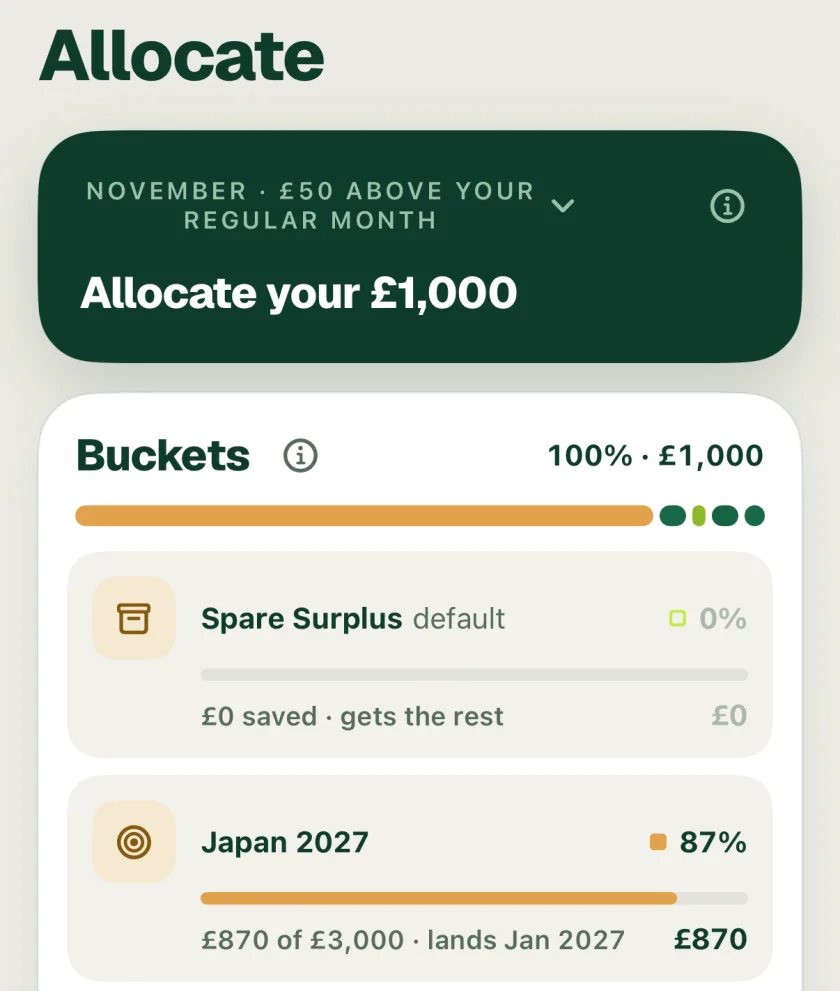
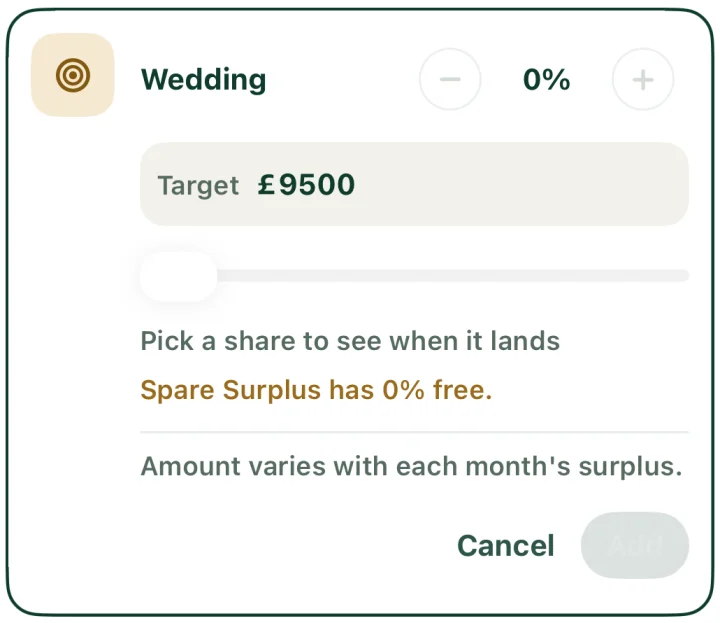
In Allocate, part of Surplus Pro, choose Add a goal in the Buckets card. Name your goal, enter its target amount and choose a share of your monthly surplus. Surplus shows this month’s planned contribution and projects when you’ll reach the target. The pound amount varies with each month’s surplus. There’s no date to pick: for a wedding, the share needs to be high enough for the projected month to come before the last balance is due. A planned amount is not money moved: the transfer to your wedding savings is yours to make.
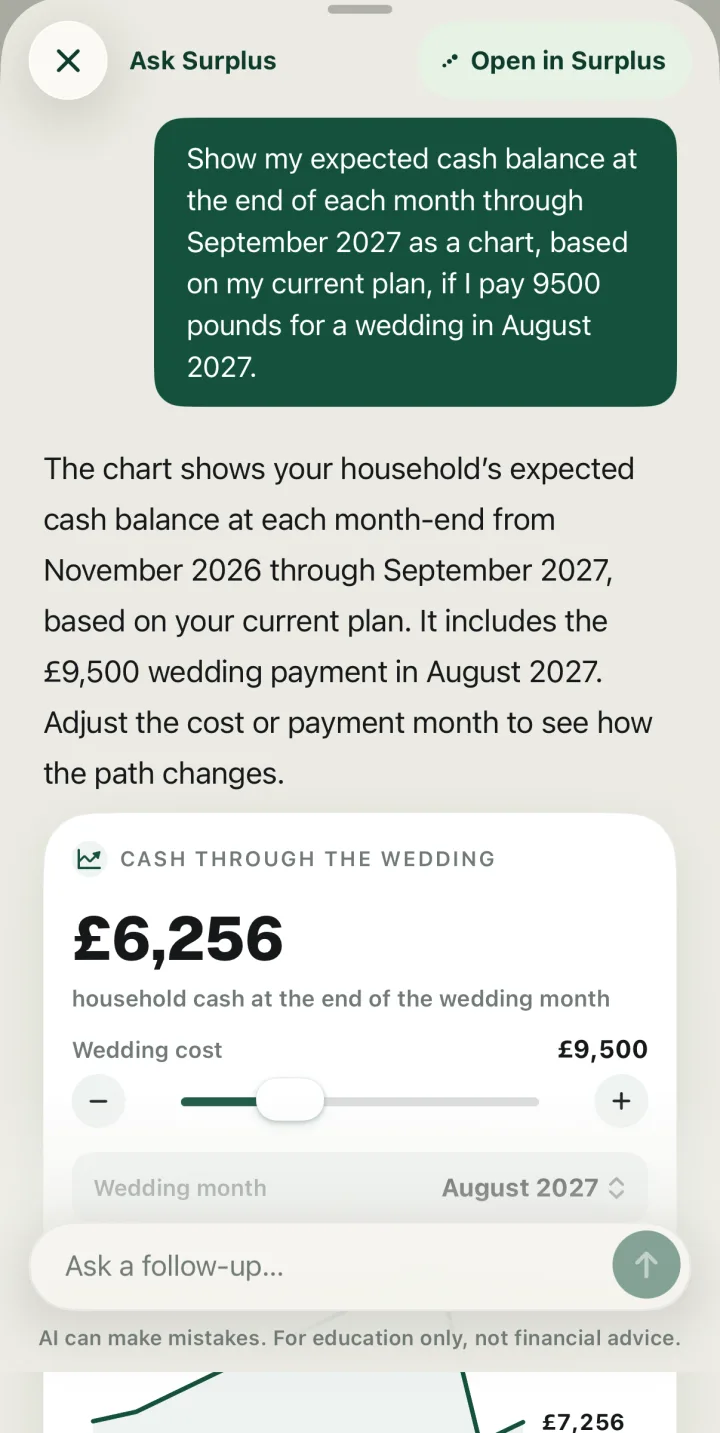
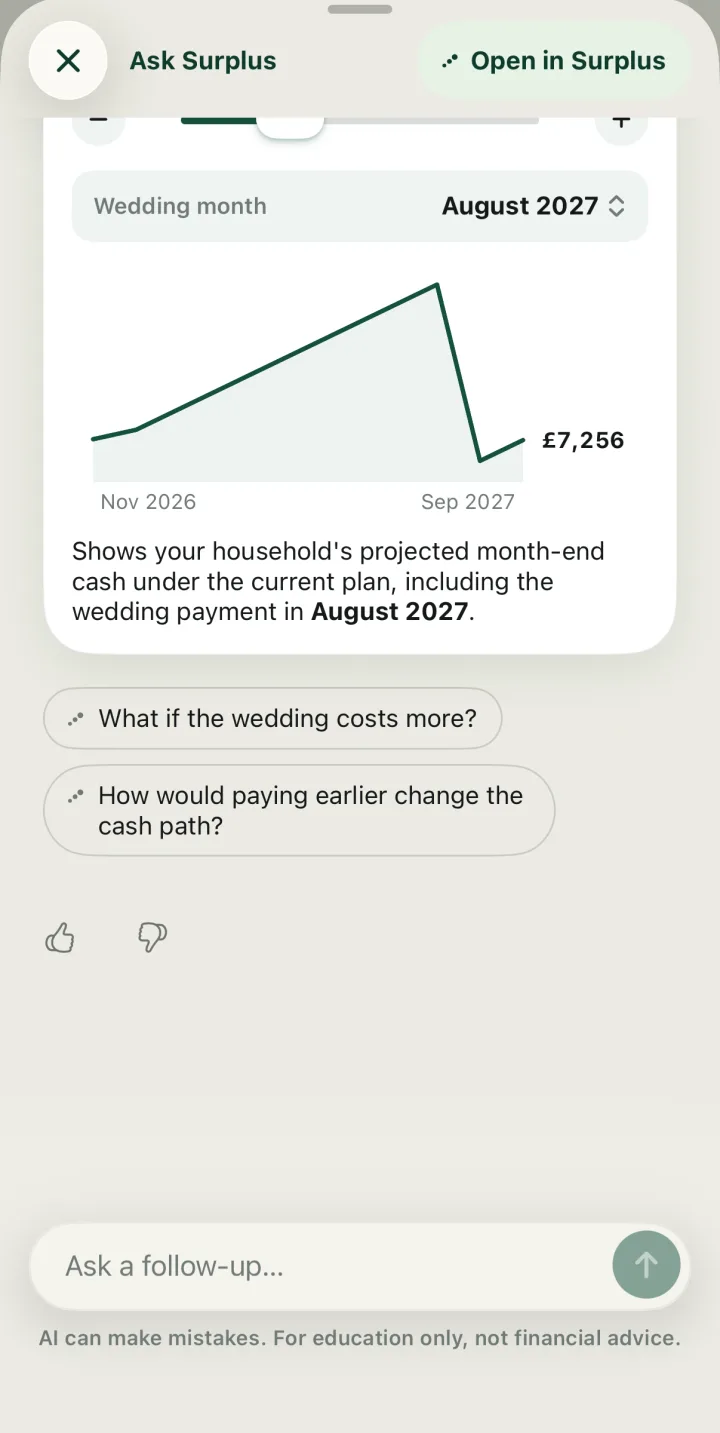
Ask Surplus, part of Surplus Pro, to show your projected cash balance over the coming months, based on your current plan. You can also ask how a planned expense would change it, such as the wedding itself. The answer shows the cash left at the end of that month and a chart of each month-end. The cost and the month can be changed in the answer. AI can make mistakes. For education only, not financial advice.
In Surplus Free, Add a virtual bucket in Net Worth records savings held in an account Surplus can’t see, such as a wedding savings account. The Your Complete Picture feature page shows net worth in the app.
Sources
Every figure above is checked against these primary sources - and re-checked whenever the rates move.
| Source | Accessed |
|---|---|
| How much does an average wedding cost? - MoneyHelper www.moneyhelper.org.uk/en/blog/life-events/how-much-does-an-average-wedding-cost | |
| How to create your wedding budget - MoneyHelper www.moneyhelper.org.uk/en/blog/life-events/how-to-create-your-wedding-budget | |
| Marriages and civil partnerships in England and Wales: plan your ceremony - GOV.UK www.gov.uk/marriages-civil-partnerships/plan-your-ceremony | |
| Marriages and civil partnerships in England and Wales: give notice - GOV.UK www.gov.uk/marriages-civil-partnerships/give-notice | |
| How Inheritance Tax works: rules on giving gifts - GOV.UK www.gov.uk/inheritance-tax/gifts |
Common questions
How much does a 100 person wedding cost in the UK? +
It depends on the cost of one guest and the fixed costs. In this guide's illustrative example, 100 guests at £100 a head plus £6,000 of fixed costs makes £16,000, against £9,500 for 35 guests. MoneyHelper puts the average guest list at 80 to 100 people, so 100 guests is at the top of the usual range.
What is the most expensive part of a wedding? +
In MoneyHelper's list of the top five wedding costs, the venue comes first, then the honeymoon, food, the engagement ring and drinks. Its average venue cost is £8,400. Food then grows with every guest, at around £70 a head.
Is 20k enough for a wedding in the UK? +
It depends on the guest list. Take the fixed costs off £20,000 and divide what is left by the cost of one guest: that is how many guests it covers. In this guide's example, £6,000 of fixed costs and £100 a head leaves room for 140 guests.
What is the cheapest month to get married? +
MoneyHelper doesn't name one month. It says weddings outside the April to September peak season or on a weekday can cost less. A summer wedding could cost up to 4 times as much as a winter one.
Do the engagement ring and honeymoon count in a wedding budget? +
It depends on what the savings are for. If one pot is paying for everything, each goes in the target as its own line with its own due date. A ring already bought or a honeymoon with its own savings stays out. The £24,069 average counts both, which is one reason it sits above averages that leave them out.
Researched and written by Shiv Patel, chartered accountant (ICAS), with AI drafting assistance. Every figure is checked against the cited source. Guidance, not personal advice.